Home / Technology / Band-switched Data Transmission (BSDT)
band-switched

Band-switched Data Transmission (BSDT)

Optimises the path by flexibly switching bands according to RF conditions and device type.

Overview

BSDT — intelligent band switching

Significantly boosts the number of connections on the 2.4GHz band and reduces congestion compared to conventional methods, while optimizing throughput by combining both bands simultaneously: 2.4GHz for strong obstacle penetration and 5GHz for extremely high bandwidth. As a result, IoT devices operating on the 2.4GHz band also benefit from extended range and higher speeds via the 5GHz band.

band-switched

Technology solution

Applications

This technology was developed by Wicell Network. It enables band-switched data transmission.

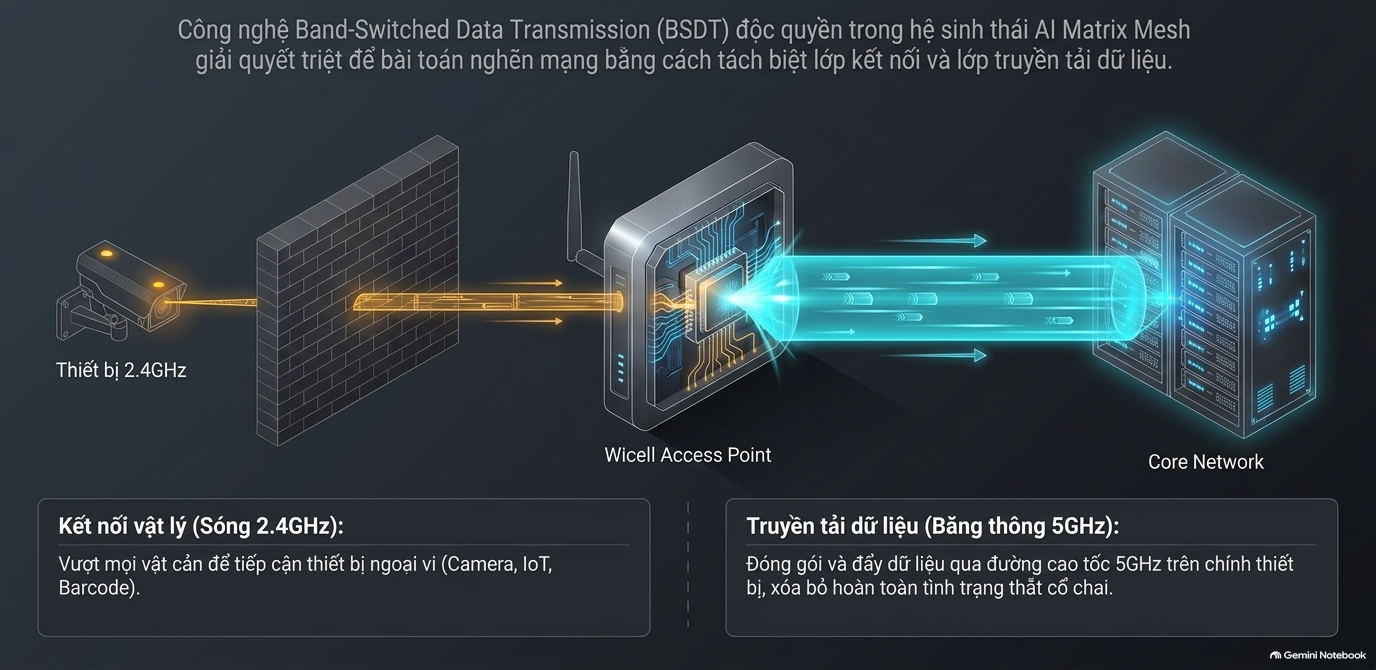
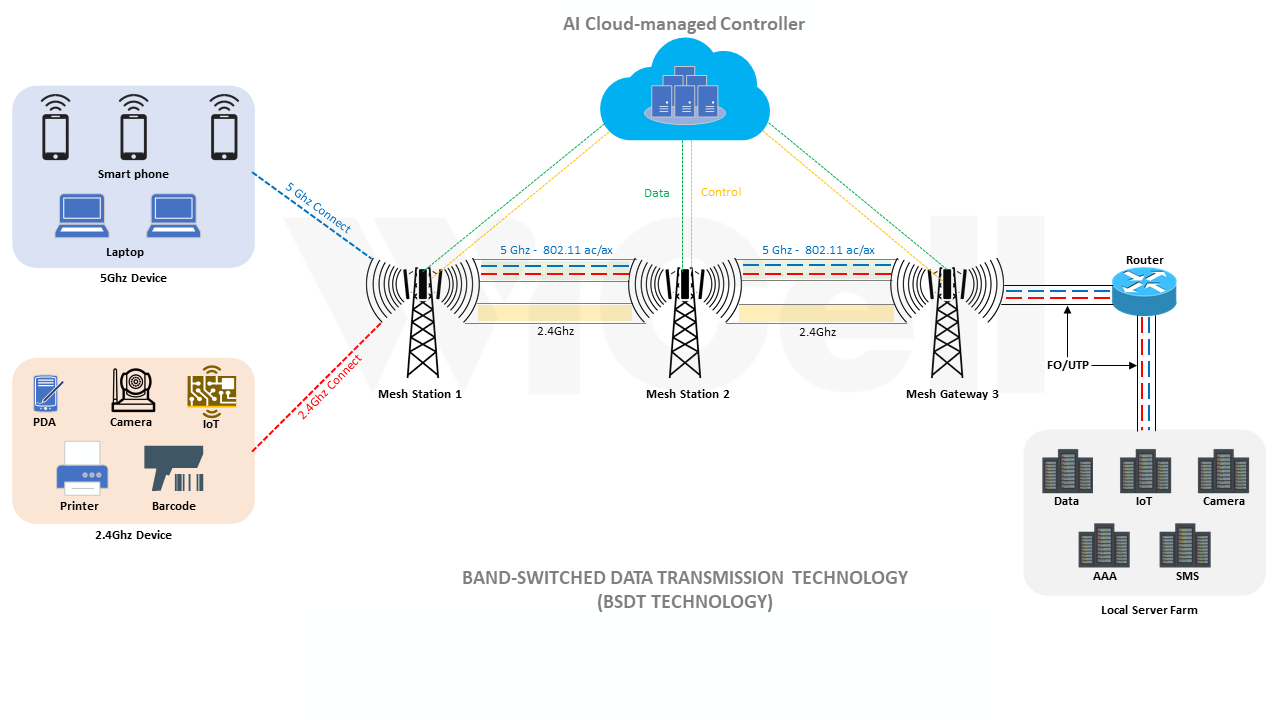
Band-switched data transmission is a technique used in Wicell Network's AI Matrix Mesh technology for dual-band devices. When devices that support only the 2.4GHz Wi-Fi band — such as Wi-Fi cameras, handheld barcode scanners, IoT devices, older laptops or smartphones, and automated control devices — connect to a Wi-Fi access point, that access point uses the 5GHz bandwidth of the device itself to transmit data, internet traffic, video,...

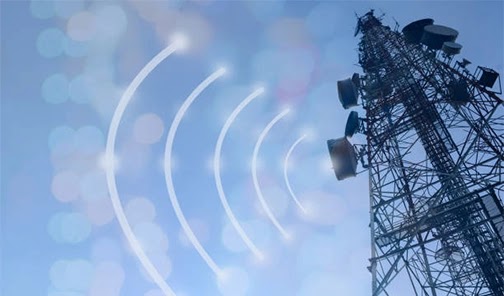
Minh họa công nghệ Band-switched Data Transmission (BSDT)

Benefits

Boosts 2.4GHz capacity

Significantly increase the number of 2.4Ghz frequency connections.

Reduced Channel Congestion

Prevent data congestion on the 2.4Ghz band in the usual way.

Optimizes dual-band bandwidth

Optimize bandwidth by combining 2 bands at the same time: 2.4GHz penetrates obstacles well and 5Ghz has extremely high bandwidth, so more and farther data is transferred.

Extended IoT Coverage Range

Support for devices (IoT) that use transmission technology on the 2.4Ghz band that transmits farther at higher speeds than on the 5GHz band.

Zalo